
AI Agents in Business: The Next Evolution of Intelligent Operations
AI platforms have become part of everyday life, helping people simplify tasks, answer questions, and save time on repetitive work. Tools such as ChatGPT and Gemini usually respond to instructions given by users. But what if AI could go beyond answering prompts and start analyzing information, planning the best course of action, and completing tasks across different systems?
That is where AI agents come in. AI agents are intelligent software systems that can understand goals, reason through information, use digital tools, and take actions to complete specific tasks. Instead of acting as passive tools that wait for instructions, AI agents can become active participants in business workflows. They can help schedule meetings, gather information from multiple sources, generate reports, support customers, monitor progress, and coordinate tasks across teams.
For businesses, this represents an important shift. AI agents are not just another productivity tool. They are becoming a practical way to improve efficiency, support decision-making, and reduce the time employees spend on repetitive administrative work.
Why Are AI Agents Gaining Attention?
Businesses are operating in a faster, more connected, and more data-driven environment than ever before. Customer expectations are increasing, teams are using more digital tools, and organizations need to make decisions quickly while managing large amounts of information.
This has increased the demand for business process automation with AI. Effective automation can help organizations reduce costs, improve accuracy, speed up decision-making, and free employees to focus on higher-value work.
At the same time, advances in large language models and AI technology have made AI agents more capable. Modern AI systems can understand context, generate human-like text, analyze large volumes of information, and assist with complex tasks that previously required significant human effort. As these capabilities improve, AI agents in business operations are becoming more relevant than ever.
Key Business Use Cases for AI Agents
AI agents can support many areas of business operations, including:
- Customer Support: Answering routine questions, reducing response times, and escalating complex cases.
- Sales and marketing: researching prospects, preparing follow-up emails, and personalizing outreach.
- Project management: tracking task progress, summarizing updates, and identifying blockers.
- Human resources: assisting with onboarding, policy questions, and employee support requests.
- Finance and reporting: reviewing invoices, tracking payments, analyzing pricing and margins, and preparing financial summaries.
- Legal and contract management: comparing contracts, identifying risks, suggesting wording, and drafting correspondence for review.
- IT and service management: helping users resolve common issues, route tickets, and monitor service requests.
By handling repetitive and time-consuming activities, AI agents allow employees to focus on strategy, creativity, problem-solving, and customer relationships.
A Practical Example: How PMOBytes Is Using AI Agents?
PMOBytes provides a practical example of how AI agents can be adopted inside a business operation. Instead of treating AI as only a concept, PMOBytes is implementing Mandy, a Hermes agent, as the main AI coordinator supported by seven specialized sub-agents covering marketing, sales, administration, quality assurance, development, finance, and legal and contract review.
This model makes AI adoption easier to understand because each agent has a clear purpose, clear responsibilities, and human oversight.
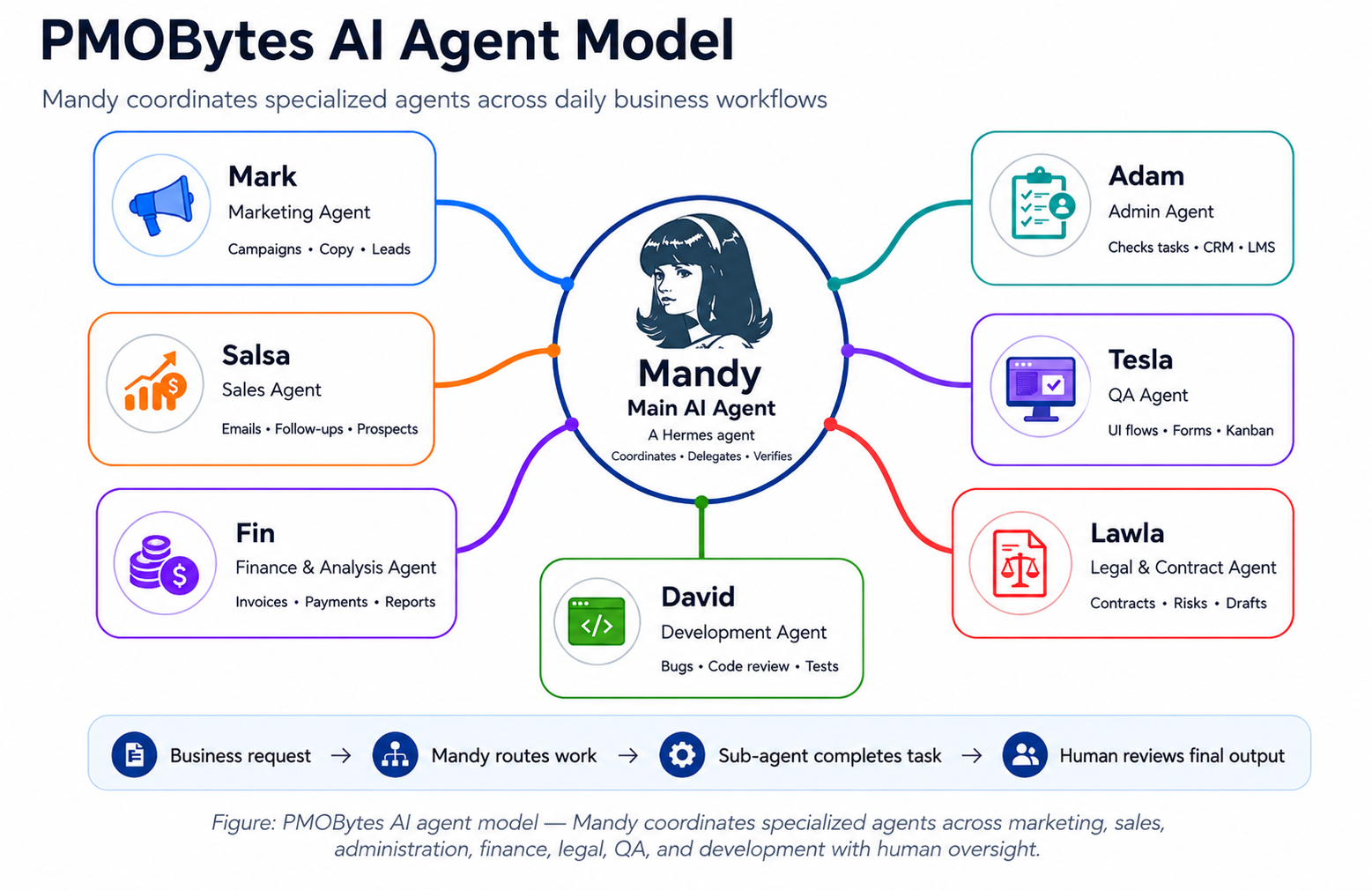
Agent roles and responsibilities:
1. Mandy – Main AI Agent:
- Receives business requests and understands the overall goal.
- Coordinates the workflow across the right sub-agents.
- Delegates tasks, reviews outputs, and reports verified results.
- Keeps human approval in place for important decisions.
2. Mark – Marketing Agent:
- Creates campaign ideas and marketing angles.
- Improves website copy and landing page messaging.
- Prepares LinkedIn posts and webinar promotion content.
- Suggests content ideas for PMOBytes and QPunch.
3. Salsa – Sales Agent
- Prepare personalized email drafts.
- Creates follow-up messages for prospects and clients.
- Supports prospect research and outreach preparation.
- Helps organize sales communication before human approval.
4. Adam – Admin Agent
- Supports QPunch administration and task creation.
- Updates CRM fields, assignees, comments, and task details.
- Verifies IDs, links, and task information.
- Helps keep operational updates structured and traceable.
5. Tesla – QA Agent
- Tests QPunch user flows and Kanban workflows.
- Checks website pages, forms, links, and navigation.
- Reports bugs, blockers, and quality issues clearly.
- Supports UI-based verification before changes are accepted.
6. David – Development Agent
- Reviews code and investigate reported bugs.
- Run tests and check small fixes.
- Supports safe development improvements.
- Provides verified development summaries for review.
7. Fin – Finance & Analysis Agent
- Reviews invoices, payment records, and financial transactions.
- Supports reconciliation, pricing analysis, and margin calculations.
- Assists with currency conversions and financial data verification.
- Prepares financial summaries and reports for human review.
8. Lawla – Legal & Contract Review Agent
- Reviews and compares contracts, agreements, and commercial terms.
- Identifies potential legal and commercial risks requiring attention.
- Suggests improvements to contractual wording and clauses.
- Prepares professional correspondence drafts for human review, without replacing the advice of a licensed legal professional.
Human oversight: Important actions remain reviewed and approved by people, ensuring accuracy, accountability, and responsible decision-making across business operations while keeping the process practical, controlled, and secure.
This example shows that AI adoption does not need to begin with a large transformation project. It can begin with focused agents that support different business functions, streamline workflows, improve team productivity, and create a repeatable model for future client solutions.
Challenges and Considerations
Although AI agents are powerful, businesses need to use them carefully. Since AI agents often need access to information in order to perform tasks, data privacy and security are major considerations. If access is not properly controlled, sensitive information such as emails, documents, customer records, or internal company data could be exposed.
Accuracy is another important issue. AI agents in businesses can improve efficiency, but their output is not always guaranteed to be correct. Human oversight is still necessary to verify information, review decisions, and prevent errors.
Organizations also need to consider ethical concerns such as bias, transparency, accountability, and privacy. Clear governance policies, permission controls, monitoring, and human review should be part of any AI agent adoption strategy.
Human-AI Collaboration
AI agents are not designed to completely replace people. They are most effective when they work alongside humans.
Humans bring creativity, judgment, leadership, emotional intelligence, and business context. AI agents bring speed, consistency, data-processing ability, and automation. When these strengths are combined, organizations can become more productive and make better decisions.
The goal is not to remove the human element from work. The goal is to reduce repetitive tasks so people can spend more time on work that requires critical thinking, communication, innovation, and strategic judgment.

Final Thoughts
AI agents are moving from an emerging concept to a practical business tool. By combining automation, reasoning, and decision-making capabilities, they go beyond traditional software and support end-to-end workflows.
Their true value is not in replacing human effort, but in enhancing it. When humans and AI agents work together, organizations benefit from the speed and consistency of AI as well as the creativity, judgment, and leadership of people.
As AI agents continue to develop, they will become more integrated into everyday business operations. Organizations that learn how to adopt them responsibly will be better positioned to improve productivity, innovate faster, and stay competitive in an increasingly digital world.
For organizations exploring where to begin, the best first step is simple: identify repetitive workflows that consume time every week, then test one focused AI agent with clear goals, controlled access, and human review.